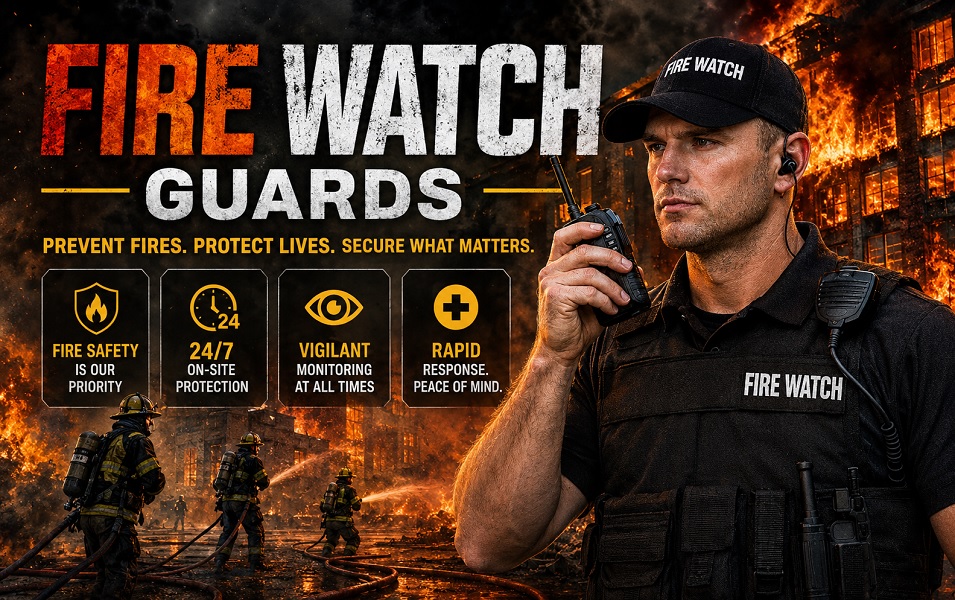
There’s a moment every property manager dreads — the fire alarm panel goes dark, the suppression system goes offline, and suddenly an entire building full of people is exposed. That gap between system failure and full restoration is exactly where Fire Watch Guards step in, and right now, demand for this specialized service is surging across the United States like never before.
The numbers tell a compelling story. Commercial construction is booming. Aging infrastructure in legacy buildings is failing at accelerating rates. And stricter regulatory environments are leaving property owners with fewer options when their fire detection systems malfunction. Across industries — from hospitality and healthcare to warehousing and high-rise residential — the call for trained fire watch personnel has become one of the fastest-growing segments within the private security sector.
Why Fire Systems Fail More Than You Think
Most building owners assume their sprinkler systems, smoke detectors, and alarm panels will simply work. The reality is far more complicated.
Equipment malfunctions, delayed maintenance schedules, construction interruptions, and software failures routinely knock fire protection systems offline — sometimes for hours, sometimes for days. National fire safety data consistently shows that equipment malfunctions and deferred maintenance are among the leading contributors to elevated fire risk in commercial buildings. Fire departments across the country continue to report high call volumes tied directly to alarm failures and defective suppression systems.
When a system goes down, the law doesn’t wait. Most jurisdictions — governed by NFPA codes, local fire authority requirements, and OSHA standards — mandate that properties maintain continuous fire monitoring the moment a primary system becomes non-operational. That mandate is what drives an immediate, non-negotiable need for trained human presence on-site.
The Anatomy of a Modern Fire Watch Operation
Gone are the days when fire watch meant posting a single guard with a clipboard and a flashlight. The profession has evolved into a sophisticated, credential-driven discipline with a defined operational framework.
Today’s fire watch professionals arrive equipped with OSHA credentials, NFPA training certifications, GPS tracking devices, and — increasingly — AI-assisted thermal imaging tools capable of detecting heat signatures that the human eye would miss entirely. Companies operating at the leading edge of the industry are integrating blockchain-verified reporting logs, ensuring that every patrol round, every observation, and every compliance entry is tamper-proof and audit-ready. In trials, AI-assisted heat mapping equipment has been shown to detect significantly more latent hazards compared to conventional spot-check temperature tools.
Real-time dispatch accuracy has become a competitive differentiator. Fire safety companies adopting artificial intelligence for dispatch coordination can now reduce response lag, matching the right credentialed guard to the right facility type within minutes of a system failure notification — a capability that was virtually impossible just five years ago.
Construction Sites: The Epicenter of Demand
If there’s a single sector driving the current surge in fire watch services, it’s commercial and industrial construction. Active construction zones are uniquely high-risk environments — open flame work, welding operations, temporary wiring, and the absence of permanent fire suppression systems create a sustained need for dedicated fire safety monitoring throughout the build cycle.
“Hot work” — the industry term for welding, cutting, brazing, and similar operations — requires a designated fire watch presence during and after any such activity, typically for a minimum period following task completion. On large-scale projects, this can mean multiple guards patrolling different zones simultaneously, logging observations at precise intervals, and coordinating directly with site supervisors and local fire marshals.
The construction sector isn’t slowing down. Infrastructure investment, urban densification, and the reshoring of American manufacturing are all fueling a pipeline of projects that will sustain demand for professional fire watch personnel well into the next decade.
Healthcare, Hospitality, and the High-Stakes Sectors
Beyond construction, fire watch guards have become an essential operational component for industries where occupant safety risk is at its most acute.
Hospitals and healthcare facilities operate under some of the most rigorous fire safety compliance frameworks in existence. When a suppression or detection system goes offline — even temporarily for scheduled maintenance — the consequences of non-compliance aren’t measured in fines alone. Human lives are directly on the line. The same logic applies to hotels, senior living communities, and large event venues, where the combination of high occupancy, limited mobility populations, and complex floor plans creates a risk profile that demands human vigilance, not automated alternatives.
Facility managers in these sectors are increasingly embedding fire watch services into their routine maintenance planning rather than treating them as emergency responses. That cultural shift — from reactive to proactive — is one of the clearest indicators of how seriously the industry is now taking continuous fire safety coverage.
The Compliance Pressure That’s Reshaping Business Decisions
Regulatory compliance is no longer a background consideration for business owners. It’s a front-line operational concern with direct financial implications.
Insurance carriers are tightening underwriting criteria for commercial properties, increasingly requiring documented evidence of fire watch coverage during system outages as a condition of policy maintenance. Properties that fail to demonstrate proper fire watch protocols during an incident investigation can face claim denials, premium spikes, and in severe cases, policy cancellation. The financial exposure of non-compliance has become, for many property owners, a more immediate motivator than the fire risk itself.
Local fire authorities have also expanded their inspection and enforcement activities. Municipalities across the country are dedicating more resources to proactive compliance checks rather than waiting for incidents to trigger reviews. For businesses operating in jurisdictions with active enforcement postures, the question isn’t whether to maintain fire watch coverage — it’s how quickly they can get qualified personnel on-site.
What Sets Professional Fire Watch Apart
The private security industry is crowded. Not every provider offering fire watch services delivers the same quality of personnel, documentation, or regulatory competence.
The markers of a credible fire watch operation are specific and verifiable. Guards should hold current NFPA training certifications and OSHA-recognized credentials. Providers should offer real-time GPS patrol documentation, ensuring every round is logged with time, location, and observation detail. Reporting infrastructure matters enormously — digital or blockchain-verified logs create defensible compliance records that hold up under insurance audits and fire authority review.
Response time is another non-negotiable. A fire watch deployment that takes six hours to materialize after a system failure isn’t a solution — it’s a liability. The benchmark among leading providers is measured in minutes, not hours, with 24/7 dispatch capabilities and pre-vetted guard pools that can be activated on immediate notice.
The Human Element in an Automated Age
There’s an irony worth noting here. Across virtually every domain of commercial security, the industry trend points toward automation — cameras, sensors, AI monitoring platforms, and remote operations centers replacing boots on the ground. Fire watch runs counter to that current, and for good reason.
Automated systems are, by definition, the thing that has failed when fire watch services are deployed. The entire premise of the service rests on the irreplaceable value of trained human judgment — a guard who can smell something burning before thermal sensor triggers, who can identify a blocked exit route during a patrol, who can communicate directly with occupants and emergency responders in real time. No algorithm replicates that.
The rising demand for fire watch guards is, in part, a market correction — an acknowledgment that human presence in high-risk environments isn’t an anachronism. It’s an operational necessity that no amount of technological sophistication has yet managed to replace.
A Market on the Move
The fire watch services market sits at a compelling intersection of regulatory momentum, construction growth, insurance pressure, and genuine public safety need. Providers who can deliver credentialed, rapidly deployable, and compliance-documented personnel are not just filling a service gap — they are building a business category with durable, structural demand.
For property owners, facility managers, and construction operators, the calculus is straightforward. The cost of maintaining proper fire watch coverage during a system outage is measurable, predictable, and manageable. The cost of not having it — in liability exposure, insurance consequences, regulatory penalties, and irreversible harm — is not. That asymmetry is what makes this market’s growth trajectory not just plausible, but inevitable.